
If you only make one historically grounded garment for faire season, make a kirtle. It sits between the linen smock and the gown, it supports the body without a separate corset, and for a great many sixteenth-century women it was the outermost layer they wore on an ordinary working day.
What a kirtle is
In its simplest form a kirtle is a fitted bodice joined to a full skirt, worn directly over the smock. Earlier in the century it was the standard under-layer beneath a gown; as the century went on, fashionable dress separated bodice and skirt into bodies and petticoat, but the kirtle carried on in working wardrobes, in the country and in the kitchen. Paintings of markets and kitchens from the Low Countries are full of them, usually with the sleeves rolled up and an apron tied over the skirt.

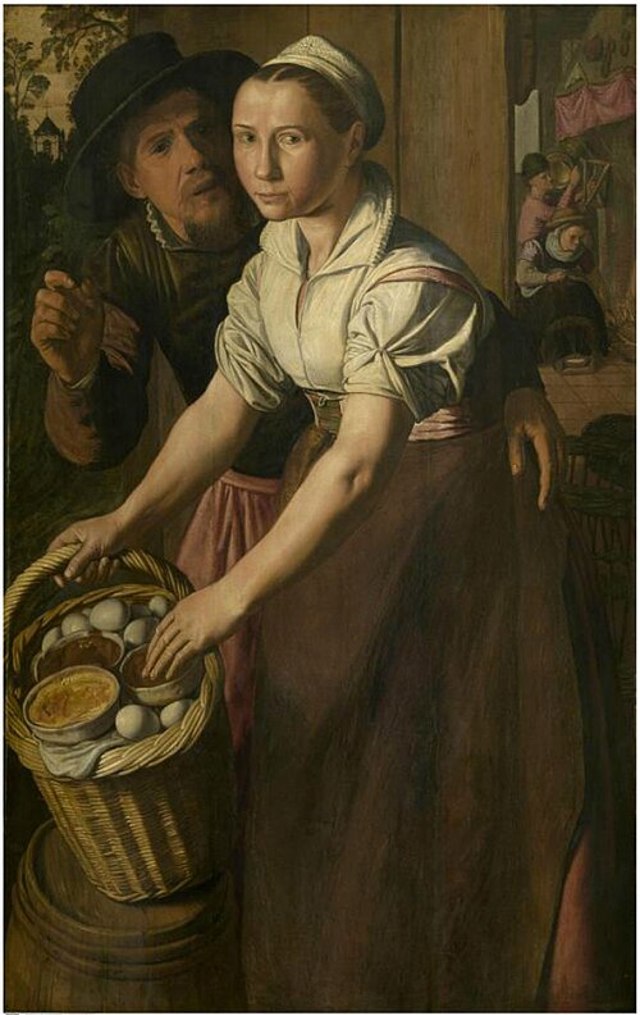
Support comes from fit, not bones
The bodice of a supportive kirtle does the work of a corset by being cut close and made firm. Several layers of linen, sometimes with a stiffer canvas interlining, are quilted or stitched together so the front stays smooth and flat. Some makers add a few reeds or cords at the lacing edge to keep it from wrinkling, but the real secret is the fit: snug through the ribcage, with the bust supported from below and the front held flat against the body.
Fit the kirtle first. Every layer above it is only as good as the shape underneath.
That is why the kirtle fixes everything above it. A gown laid over a well-fitted kirtle hangs smoothly because there is nothing for it to fight against. A gown laid over a loose or wrinkled one inherits every problem, and no amount of adjusting the gown will cure it.
Lacing, straps and sleeves
Kirtles were laced closed, at the front, the side or the back, with a single lace worked in a spiral through offset eyelets. Front lacing is the most practical choice if you dress yourself at a faire. Shoulder straps keep the bodice from sliding down and are worth fitting carefully; set them a little towards the neck so they do not slip off the point of the shoulder.
Sleeves were very often separate, tied or pinned on at the armhole. That makes a single kirtle remarkably versatile: plain linen sleeves for work, a better pair for a feast day, or no sleeves at all in high summer.
Fitting it on a real body
- Make a toile from strong, cheap fabric and fit it laced, not pinned, so you feel the real tension.
- Fit with the smock on. A few millimetres of linen change how the bodice sits.
- Leave a gap of two or three centimetres at the lacing edges. Edges that meet when new will gape once the fabric relaxes.
- Check the fit sitting down. If the front digs into your thighs, the bodice is too long.
Once the toile is right, the kirtle itself is straightforward sewing. The time goes into the fitting, and it is time well spent: the same pattern will serve you for years, under every gown you make afterwards.


